The Binance hack has triggered a major security investigation after the exchange reported approximately $6.3 billion in stolen token assets. Binance says it will absorb the financial impact using its own resources. Its latest formal update describes a phased withdrawal restart, further technical investigation and a forthcoming Proof of Reserves report. These are company statements and targets, rather than independently verified completion milestones.
Binance hack: the latest confirmed statements
In Security Incident Update #2, Binance places the hot-wallet compromise at approximately 29 October 2026, 20:05 UTC. That corresponds to 30 October, 01:05 in Pakistan. The exchange estimates the loss at $6.3 billion and says deposits and unaffected services remain operational while withdrawals are suspended.
The same announcement targets the start of a phased withdrawal restart within approximately 34 hours, subject to security checks. It also plans an initial reserves snapshot within 12 hours and results by Monday, 2 November 2026. Those intervals belong to that announcement; they are not fresh countdowns starting whenever someone reads this article.
Binance expects further verified technical findings within about 48 hours, provided disclosure does not harm the investigation. At publication, the reviewed sources do not establish that withdrawals have resumed or that Binance has released the final technical report.
What the $6.3B, $6.34B and $3B figures mean
Three different numbers appear in the Binance hack updates. They describe separate things; adding them together would produce a misleading recovery total.
| Figure | Meaning |
|---|---|
| About $6.3 billion | Estimated impact of stolen token assets. |
| More than $6.34 billion | Company funds reserved to cover the incident. |
| $5 billion | Reserved funds already held in the affected token assets. |
| About $3 billion | Affected assets reportedly frozen with partners. |
Binance’s official recovery post on X says it is acquiring the remaining relevant tokens through market and over-the-counter channels. It explains that thin liquidity and settlement times can slow this work. Crucially, its company-funding figures exclude frozen or protected assets, which still require recovery and verification.
Freezing funds is not the same as returning them. Likewise, setting aside resources is different from completing purchases in every required token. The distinction matters when assessing what has actually been completed versus what remains a commitment.
How the Binance hack investigation changed
The initial technical statement suggested a compromised DevOps engineer’s laptop may have enabled access to a service container and unauthorized withdrawal transactions. Binance reported finding no evidence of leaked wallet private keys. It also said it had revoked the affected address authorization and brought in law enforcement and blockchain intelligence partners.
That preliminary explanation was not the complete finding. In a subsequent investigation update, Binance disclosed additional breach points and described a complex attack. It said the unauthorized outflows stopped when it paused withdrawals. The company reiterated that it would cover losses through the Secure Asset Fund for Users, or SAFU, and company funds.
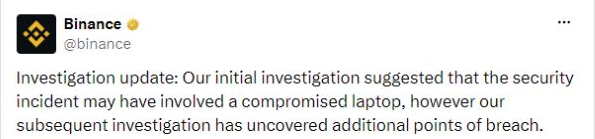
“No evidence” of a key leak is a statement about the investigation so far. It does not prove that every authorization or signing control worked correctly. A final account needs to explain how attackers gained access, how Binance handled approvals and why its controls failed to stop the activity sooner.
What Richard Teng said on X
Binance Co-CEO Richard Teng published a video update and an accompanying written transcript. He identified USDC, USDT, BTC, ETH and BNB among the tokens Binance had already reserved. He said the attackers destroyed tools and traces as they progressed, making investigation harder. Teng also alleged that EIP-7702 delegation gave on-chain execution approval over a hot wallet without passing through Binance’s normal approval controls.
Teng said the affected hot wallet belonged to Binance and that Binance held most user assets in cold wallets. He described a company-wide review covering endpoints, cloud infrastructure, key management and signing. He said Binance was rebuilding withdrawal infrastructure and would only restore it after rigorous testing. These descriptions remain attributed to Binance; TechRehman has not inspected its internal systems.
One important EIP-7702 clarification
Teng’s transcript calls EIP-7702 a multi-signature protocol. The Ethereum specification defines it as a transaction mechanism that lets externally owned accounts delegate code execution. It is not simply a standard multi-signature wallet protocol.
The specification warns that delegated code has broad account access and that insecure implementations can allow an attacker to take control. That provides useful context, but it does not independently prove Binance’s particular attack sequence. Establishing that connection requires verified incident evidence.
Binance hack withdrawals: why the timelines differ
Binance’s service update on X initially described an expected restart within 48 hours. A later investigation post referred to 45 hours, Teng’s transcript discussed a target within 40 hours, and Update #2 subsequently specified approximately 34 hours for a phased restart.
These are successive estimates issued at different stages. Readers should not interpret them as four independent outages or as guaranteed deadlines. The latest formal statement makes security checks a condition, and a phased restart does not mean every asset and network becomes available simultaneously.
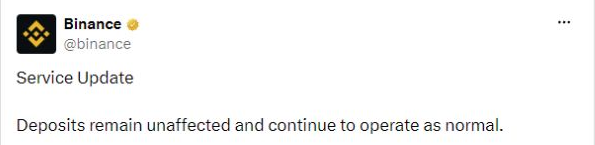
Early wording said Binance had suspended both deposits and withdrawals. The updated original announcement explicitly clarifies that deposits remain unaffected. Readers should therefore avoid circulating the older wording as the current service status.
What users should verify next
For the Binance hack, the next useful evidence is operational: withdrawal reopening notices, token-specific availability, completed replacement purchases, reserves reporting and the technical post-mortem. An announcement of intention is valuable, but Binance needs to follow it with evidence that the promised work happened.
Read any reserves release together with its timestamp, covered assets, corresponding user balances and verification method. A snapshot describes a particular point in time. It cannot automatically prove that Binance has fixed every security weakness.
Use Binance’s official app, announcements page or support center to check your own account. Keep records of balances, pending withdrawals and support references. Do not publish account screenshots containing personal details. Treat unsolicited recovery messages cautiously, especially requests for passwords, seed phrases, wallet signatures or an upfront payment.
What remains unknown about the Binance hack
The reviewed official statements do not establish the attackers’ identities, a complete technical chain or a final token-by-token recovery total. They also do not establish compensation for every possible trading loss caused by market movements or interrupted access. The stated commitment concerns stolen funds related to this incident.
This report documents what Binance publicly says, explains the distinctions between its figures and identifies the evidence still missing. It does not recommend buying, selling or transferring assets. For our reporting standards and corrections process, see the editorial policy and corrections page. Screenshots are genuine excerpts, not recreated posts; the linked originals may receive subsequent updates.

Join the conversation
0 approved commentsAsk a question, share a useful experience or suggest a correction. Keep it constructive. Comments are reviewed before publication.