An AI voice agent is software that listens to a spoken request, decides how to respond and, when connected to approved tools, takes an action. For example, it can answer a phone call, check a booking system or route a caller to a person. A natural voice is useful, but the important question is whether the agent completes the right task and reports the result accurately.
This guide explains how the technology works, what goes into AI voice agent pricing, and how to evaluate a system before giving it real customer calls.
- Start with one repeatable task, such as after-hours inquiries or appointment requests.
- Compare the complete bill, including speech, models, telephony, integrations and human follow-up.
- Test failed bookings and unanswered transfers as carefully as successful conversations.
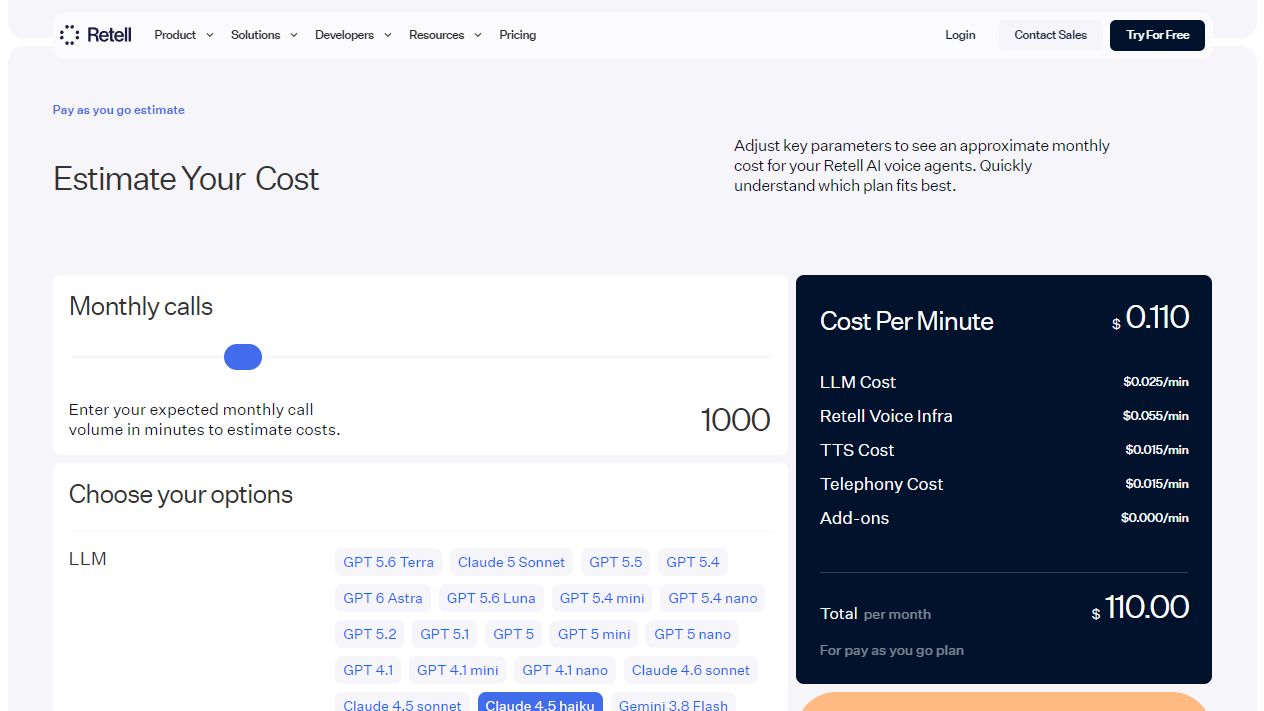
Research note: Official documentation and public pricing were checked on 3 November 2026. This is a researched guide, not a hands-on product ranking. The cost example is illustrative; the screenshot shows a public calculator, not a customer invoice.
What is an AI voice agent?
A voice agent combines a conversation system with an audio interface. The caller speaks normally; the system interprets the request and chooses its next response. Tools can connect that conversation to a calendar, customer record or support system.
That last part matters. An agent can describe a booking process without actually being able to book anything. A working appointment agent needs an integration, permission to use it and a confirmed result from the scheduling system.
The terms below overlap, but they describe different things:
| Term | What it describes | What to check |
|---|---|---|
| AI voice agent | A spoken interface that can use tools and follow a workflow. | Which actions can it actually complete? |
| AI receptionist | A job: answering, routing and handling front-desk requests. | Does the service fit your business hours and escalation rules? |
| Traditional phone menu | Predefined choices, often selected with keypad input. | Would a simple menu already solve the problem? |
| Text chatbot | A written conversation interface that may also use tools. | Does adding voice introduce worthwhile convenience? |
An AI receptionist can therefore be one application of a voice agent. For a service-buying checklist, see our separate AI receptionist costs and features guide. Here, the focus is the underlying system and how to judge its work.
How does an AI voice agent work?
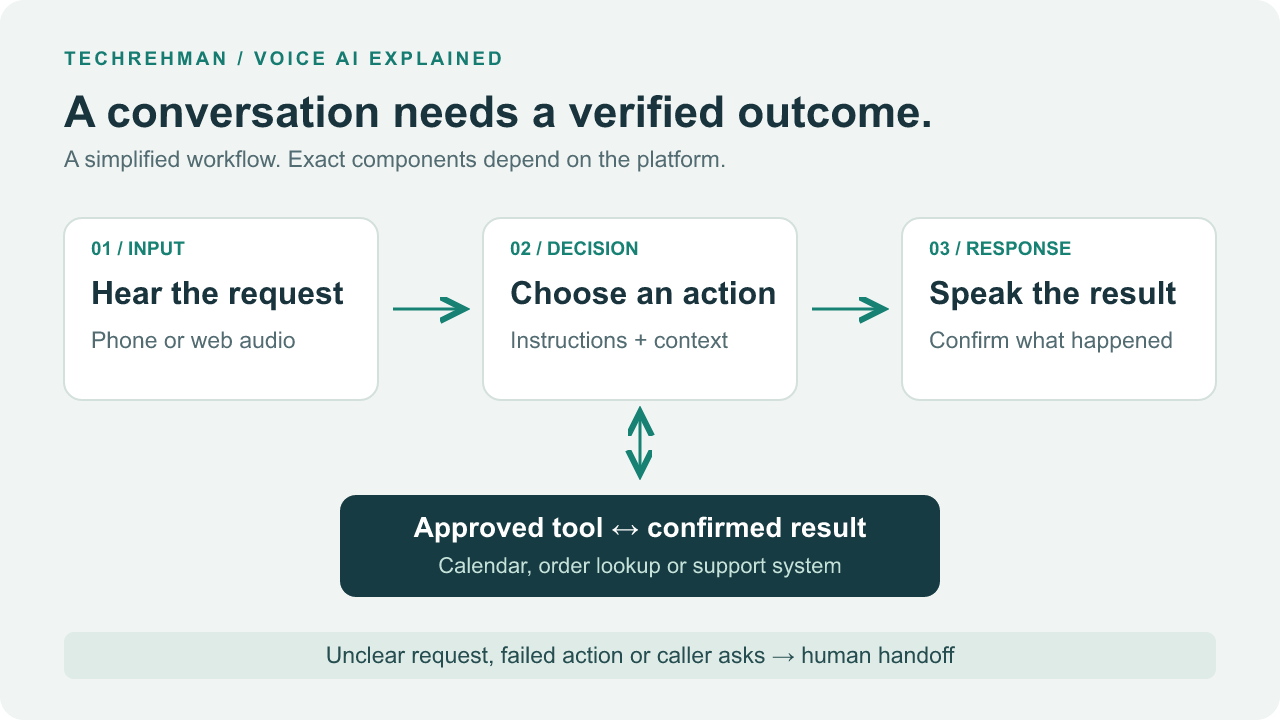
A common design connects speech recognition, a language model and speech generation. Audio arrives through a phone connection or a web application, and the components exchange information quickly enough to support a conversation.
- Listen: speech-to-text turns incoming audio into text.
- Interpret: a language model considers the request, instructions and available context.
- Act when needed: an approved tool checks or changes something in an external system.
- Reply: text-to-speech produces the spoken response.
- Manage the turn: the surrounding software handles pauses, interruptions and the next incoming response.
LiveKit’s framework documentation describes this streaming pipeline and the surrounding turn-detection and interruption handling. Some configurations instead use a real-time speech-to-speech model. Retell’s latency reference documents a separate speech-to-speech timing field, so the text-based pipeline should not be treated as the only architecture.
Knowledge and tools do different jobs
A knowledge base can supply opening hours, delivery policies or product explanations. A tool can retrieve a current order status, reserve a time slot or create a support ticket. Adding a document about appointments does not give the agent access to your calendar.
Retell’s function-calling documentation describes the sequence: the model selects a function, supplies parameters, receives a result and uses that result in the conversation. Its current guidance directs appointment scheduling to integrations such as Cal.com or Calendly; the older built-in calendar tools are no longer offered in that menu.
For a booking, define exactly what counts as success. The agent should confirm the date, local time and service, submit the request once, then read back the confirmed booking. However, if the tool times out, it should say that confirmation is unavailable and offer the agreed fallback. Confident speech is not evidence that a database changed.
Flexible conversation still needs clear boundaries
Some agents use one main prompt; others split the workflow into connected steps. A structured flow can make approvals and routing easier to inspect, but callers do not always provide information in the expected order.
Retell’s conversation-flow guide explicitly notes this trade-off. Choose structure because a task needs it, then test interruptions, corrections and changes of mind. A complicated diagram alone does not make an agent reliable.
Practical AI voice agent use cases
The most useful starting point is a task with clear inputs, a limited set of permitted actions and an outcome someone can verify. These are deployment ideas, not claims that every platform supports them automatically.
| Use case | Useful scope | Evidence of success |
|---|---|---|
| After-hours inquiries | Explain hours, service areas and the next available contact route. | Accurate answer or a message delivered to its owner. |
| Appointment requests | Check availability and make permitted bookings. | A matching record in the calendar, with the correct time zone. |
| Order-status calls | Retrieve an eligible customer’s current order information. | The answer matches the order system after the required identity checks. |
| Support intake | Collect the issue and route it to the correct team. | A usable ticket with an owner and contact details. |
For an AI voice agent for small business, narrow scope makes mistakes easier to spot. A repair company might begin by collecting the appliance type, service area and callback number. Let a person handle unusual faults and pricing exceptions until those workflows have been defined and evaluated.
Be particularly careful with actions that change money, access or commitments. A refund, account change or emergency request should follow the business’s approved process, not an improvised answer from the model.
AI voice agent pricing: what are you paying for?
Compare AI voice agent cost using the same configuration and workload. A quoted minute can include different components, and a low platform rate may exclude the telephone carrier or model provider.
A useful budgeting formula is:
Check which components are bundled before adding them together, so you do not count the same charge twice.
Retell currently advertises a voice-agent range of $0.07–$0.31 per minute. Its detailed pricing page separately lists infrastructure, voice, model, telephony and optional charges. Treat that headline range as a starting point, not a universal total for every configuration.
A worked example for 1,000 billable minutes
The following configuration uses Retell’s listed standard Claude 4.5 Haiku option, Retell Platform Voices and the listed United States Twilio telephone rate. It is a budgeting example, not a recommendation or a quote for other countries.
| Component | Listed rate | At 1,000 minutes |
|---|---|---|
| Voice infrastructure | $0.055/minute | $55 |
| Retell Platform Voices | $0.015/minute | $15 |
| Claude 4.5 Haiku through Retell | $0.025/minute | $25 |
| US Twilio telephony | $0.015/minute | $15 |
| Usage subtotal | $0.110/minute | $110 |
| One Retell phone number | $2/month | $2 |
| Illustrative subtotal | Before other costs | $112 |
This excludes taxes, optional features, billing adjustments, setup work and staff time. Check live prices before purchasing.
Check the billing exceptions
Retell documents a ten-second minimum for short calls using dynamic opening messages when the AI speaks first. It also describes adjusted LLM billing when prompt context exceeds 4,000 tokens; that context can include tool results and conversation history. Read the billing-exceptions documentation alongside the calculator.
For any provider, ask about silence, hold time, voicemail, transferred calls, testing minutes and minimum commitments. Also ask whether bringing your own carrier moves charges to a separate bill. A zero displayed platform telephony charge does not establish that the carrier is free.
Finally, measure cost per correctly completed task, not only cost per minute. Divide the total operating cost by the number of verified outcomes. If a cheaper model creates more callbacks or incorrect records, its smaller usage bill may not mean a cheaper service.
How to build an AI voice agent: a practical sequence
The exact interface depends on the provider. The following sequence is a deployment checklist, rather than a promise that any agent can be launched in a few minutes.
1. Define one job and its limits
Write down the task, required information, permitted actions and escalation route. For appointment intake, decide which services can be booked, how cancellations work and who handles exceptions. Name the person responsible for reviewing failures.
2. Prepare the information it can rely on
Collect approved answers, current business hours and relevant policies. Remove contradictory copies. Give each source an owner and an update process, so a temporary holiday schedule does not become a permanent answer.
3. Connect the smallest useful set of tools
Start with a test calendar or test records. Restrict each integration to the operations the agent needs. Define required fields and a clear success response. Arrange for repeated requests to be recognized, so a retry cannot silently create a second booking.
4. Design the handoff before launch
Specify when to transfer, where to send the call and what happens if nobody answers. A cold transfer passes the call onward immediately; a warm transfer can include a briefing before the caller joins. Exact behavior is provider-specific: see Retell’s transfer modes and limitations.
In practice, human handoff needs a real operating plan. If the team is closed, the fallback might be a callback request with a stated response window. The agent should never promise that a person is available when no one is staffing that route.
When a person takes over, pass along the caller’s goal, relevant verified details, actions already attempted and the reason for escalation. Separate what the caller said from what the system confirmed. This gives the receiving team context without presenting an unverified claim as fact.
5. Pilot, review and expand gradually
Begin with a limited queue or time window. Review completed records as well as conversation transcripts. Expand only after the common requests and failure paths behave acceptably. Keep a way to return calls to the previous process if a change causes problems.
How to test an AI voice agent beyond a polished demo
A demonstration usually follows a cooperative script. Your evaluation should include callers who interrupt, correct themselves, hesitate, ask for a person or encounter a broken integration.
The checks below are suggested acceptance tests. Define the expected outcome before running them, then record what actually happened. Do not label a conversation successful just because it ended politely.
| Test | What to observe |
|---|---|
| Correct a date mid-sentence | The final booking uses the corrected date, not the abandoned one. |
| Interrupt a long response | The agent stops appropriately and addresses the new request. |
| Use a realistic accent or noisy connection | Names and numbers are confirmed when uncertain. |
| Ask an unsupported question | The agent states its limit and follows the fallback. |
| Make the calendar unavailable | No booking is claimed without confirmation. |
| Repeat a submitted request | No duplicate record is created. |
| Request a human when the team is busy | The caller reaches the intended fallback, without a dead end. |
| Inspect the final business record | The saved details match what the caller confirmed. |
Test the actual channel, too. Retell specifically states that transfers to telephone numbers cannot be evaluated in a web call; its phone-testing guidance also covers keypad input, voicemail, SMS and audio quality. A browser conversation alone cannot validate the whole telephone route.
Measure waiting time as the caller experiences it
Check the delay after the caller finishes speaking, the time needed for a tool to finish, and the time taken to reach a person. These are different measurements.
Retell’s documented end-to-end API metric excludes turns containing only tool execution and does not include the final network trip to the user’s app. Its metric definitions are a useful reminder to read precisely what a dashboard measures.
Also review typical and slower responses, not just a single average. Compare results using the same scripts, network conditions and outcome checks. A system that answers quickly but submits the wrong appointment has not passed.
Privacy, recordings and permissions
Before sending real customer information, map where audio, transcripts, tool arguments and summaries go. Include the voice platform, model providers, carrier and your own integrations. A recording setting in one product does not describe the whole data path.
Retell’s storage documentation distinguishes full storage, storage with selected personal information removed, and basic attributes only. It also explains that automated delivery to connected systems can still expose call artifacts and that raw files are deleted after post-call processing under the relevant settings. Disabling retained recordings is therefore not the same as preventing all temporary processing or downstream copies.
Choose the least data and access needed for the task. Verify retention, deletion, staff access and integration permissions. Explain the automated service and any recording clearly to callers, and confirm applicable requirements for the places where you operate. A vendor’s compliance badge does not resolve every requirement of your own deployment.
Choosing an AI voice agent platform
Managed platforms and developer frameworks suit different teams. Retell documents a dashboard-based process for building, testing and operating agents in its platform overview. LiveKit provides an open-source framework, Python and Node.js SDKs, and deployment options described in its official introduction.
A managed service may reduce the amount of infrastructure you operate. A framework can offer more control, but someone still needs to own deployment, integrations and failures. Neither approach removes the need to test the business workflow.
Shortlist against your requirements: supported call routes, required language, integration access, data controls, export options, support and total cost. Run the same task through each candidate. Keep the one that produces correct, verifiable outcomes within your constraints.
Frequently asked questions
Can I keep my existing business telephone number?
Possibly, depending on your carrier and platform. Retell documents bringing your own telephony through SIP in its deployment overview. Confirm compatibility, forwarding or porting requirements and the failure route before changing the number customers already use.
Do I need to train a new AI model?
Not for every deployment. Platforms can combine existing models with instructions, reference information and integrations. First identify the actual failure: incorrect source information, a missing tool and poor speech recognition call for different changes. Do not assume model training is the first solution.
Can an AI voice agent handle more than one call at a time?
That depends on its concurrency limits and connected systems. Check both simultaneous-call capacity and the rate limits of your calendar or customer database. However, a platform accepting additional calls does not guarantee that every downstream action can keep up.
Use your busiest periods to estimate capacity. For example, a monthly call total can hide short bursts when several people call at once, especially when individual conversations run longer than expected.
What if the agent says a task succeeded but the record is missing?
Treat it as a failed outcome. Compare the conversation with the tool result and destination record. Keep success wording tied to a confirmed response, investigate duplicate or timed-out requests, and use a human fallback until the failure is understood.
A sensible first deployment: one well-defined task, a verified integration, a complete cost estimate and a tested route to a person. Those checks make an AI voice agent useful long before extra features do.
Image credits: Cover photograph by Claudia Mañas on Unsplash, used under the Unsplash License. The photo illustrates an audio workspace, not a tested product. Workflow diagram by TechRehman; pricing screenshot from Retell’s public website.


Join the conversation
0 approved commentsAsk a question, share a useful experience or suggest a correction. Keep it constructive. Comments are reviewed before publication.